Search This Blog

Sunday, August 31, 2014

The Murals of Wallingford (Seattle)


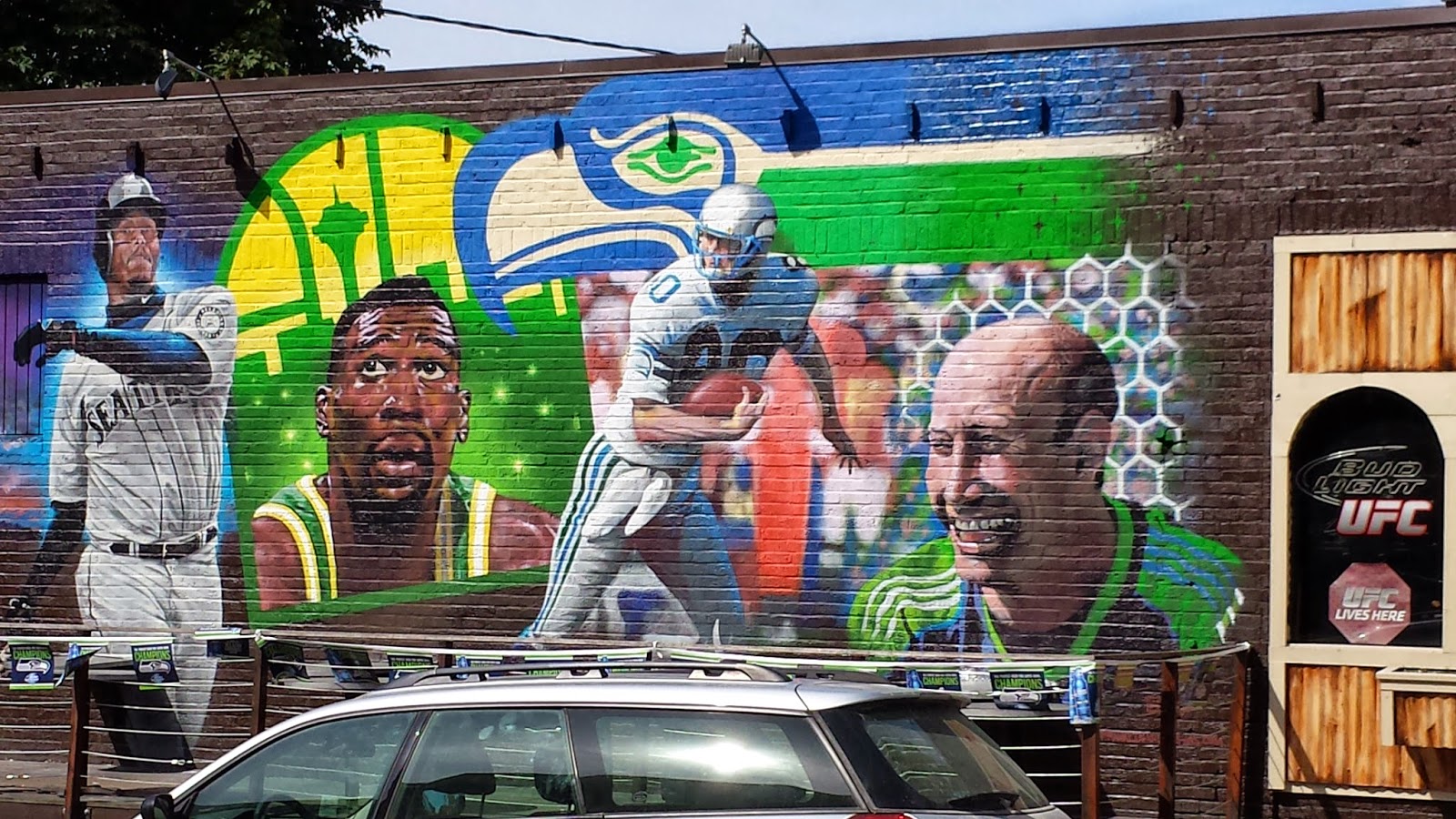
 Seattle, WA. (Wallingford).  45th & Bagley.  Sports mural at the Iron Bull. Photo: Samuel D. Gruber 2014

 Seattle, WA. (Wallingford).  Bartell Drugs Mural 45th Street and Burke Ave. N.. Photo: Samuel D. Gruber 2014

 Seattle, WA. (Wallingford).  45th Street and Burke Ave. N.  Mural by artist Chris Burnside.  Photo: Samuel D. Gruber 2014

 Seattle, WA. (Wallingford).  45th Street and Burke Ave. N. Mural by artist Chris Burnside.. Photo: Samuel D. Gruber 2014

The Murals of Wallingford (Seattle)
by Samuel D. Gruber

Since I just posted about the murals in my own Syracuse neighborhood, I thought I show what some other places are painting in their neighborhoods, too.  There are many definitions of neighborhood, but certainly one way of branding a neighborhood is to give a distinctive visual feel - and murals are a popular and relatively inexpensive way to do that.    Murals vary in quality of execution and subject matter, but even bad murals are often embraced by the local community.  What are the alternatives?  Bleak walls or even better murals.  Or, a high visually engaging urban architecture that is functional and affordable, but also visually stimulating - and fun.  In some times and places (Renaissance Italy murals were painted to enhance and expand the architecture through tromp l'oeil and other fictive devices, a technique revived in New York and other American cities by muralist Richard Haas and disciples beginning in the 1970s.  Most contemporary urban muralists seem to lack the desire or skill to match. preferring a much different aesthetic more akin to spontaneity of certain folk traditions or the slickness of advertising.


Rome, Italy. Pal. Milesi Photo: http://roma.andreapollett.com/S5/rione05.htm.

I recently had the pleasure of visiting Seattle and was fortunate to stay in the Wallingford neighborhood, just a half block off 45th Street. The half mile straight stretch is the heart of the district and is lined with dozens of restaurants, a library, movie theaters and a mix of useful and traditional stores (lamps, etc.) and a trendy new places. 

On either side are residential blocks heavy with early 20th-century Craftsman-style bungalows.  There are many murals all over Seattle, but murals are an especially distinctive part of the 45th Street district.  Some are community oriented; some advertise the businesses whose walls they adorn.  This is not an entirely new practice.  Traces of at least one old painted ad - for Henry Nelson Real Estate - is still visible.  No new mural has been painted on that wall to compete.


Seattle, WA. (Wallingford).  45th Street mural of an earlier age.  Photo: Samuel D. Gruber 2014


Seattle, WA. (Wallingford).  45th Street mural of an earlier age.  Photo: Samuel D. Gruber 2014

 Seattle, WA. (Wallingford).  45th Street mural. Photo: Samuel D. Gruber 2014

  Seattle, WA. (Wallingford).  4515 Meridian Avenue North. Photo: Samuel D. Gruber 2014

  Seattle, WA. (Wallingford).  Off 45th Street mural. Photo: Samuel D. Gruber 2014

  Seattle, WA. (Wallingford).  45th Street mural. Photo: Samuel D. Gruber 2014

  Seattle, WA. (Wallingford).  45th Street mural for Kabul Restaurant.. Photo: Samuel D. Gruber 2014

 Seattle, WA. (Wallingford).  45th Street mural. Photo: Samuel D. Gruber 2014

Saturday, August 30, 2014

Westcott Neighborhood Murals: A Primer on a Community's Artwork

Syracuse, NY. Boom Babies Mural on Harvard Pl. at Westcott St. Photo: Samuel D. Gruber

Syracuse, NY. Boom Babies Mural on Harvard Pl. at Westcott St. Photo: Samuel D. Gruber

Syracuse, NY. "Heart of the Neighborhood," community mosaic Mural on Harvard Pl. at Westcott St. Photo: Samuel D. Gruber

Westcott Neighborhood Murals: A Primer on a Community's Artwork
by Samuel D. Gruber

(Cross posted from My Central New York)

Westcott Street has been hopping this summer - with lots of street life at the cafes, restaurants, the new bakery and the Westcott Theater, a popular contemporary music venue.  The Save the Rain Project closed the street some days and caused dislocation, but it is now passed and finally the painted crosswalks have been replaced   Life on the street is good.

Westcott Street - or the "Westcott Nation" as it still sometimes called, is known visually for its murals - the biggest collection of exterior public painted and mosaic wall decoration in the city.  Compared to the mural programs in places like Philadelphia, or even on 45th Street in Seattle's Wallinford neighborhood, this is small potatoes...but the neighbors of Westcott are proud and involved in their murals, so they are not to be taken lightly.  In almost every way this a poplar art, made and promoted by many of the people who witness the murals everyday.  

Thus, I was surprised to find that there is no handy guide to the Westcott wall art.  So here is an introduction: 

The Boom Babies Mural (above), on south wall of 489 Westcott St., is one of the most popular in the neighborhood.  It was painted in 2002 by Michael Swatt and replaced an earlier work created in the 1990s.  Both of the murals utilized a flat pattern language of advertising graphics and poster art to create identification with and nostalgia for past stylish decades, recreated in the vintage and exotic fashions  offered by Boom Babies owner and mural sponsor Lorraine Koury.   The first Boom Babies mural inspired others,  initiating a what has become a tradition of mural painting in the neighborhood.

Syracuse, NY. "Heart of the Neighborhood," community mosaic Mural on Harvard Pl. at Westcott St. Photo: Samuel D. Gruber
 
Across the street at the rear of 501 Westcott Street (SE corner of Harvard Pl) facing east, is the 6' x 8' mosaic tile mural “Heart of the Neighborhood,”  designed by SU professor and former Westcott Neighborhood Association board member Marisa Temple and created by community residents,   as part of a project by the Neighborhood Association and begun at the Westcott Street Fair in 1998.  The mural was installed in 1999.

Syracuse, NY. "Peace by Piece," mosaic at Petit Library. Photo: Samuel D. Gruber

Another related mosaic mural was installed on the east wall of Petit Library in 2011.  This work was a project of local artist and teacher Ann Cofer; Ed Smith K-8 School art teacher Mary Lynn Mahan; and students from Ed Smith School.  The mosaic mural, is called Peace by Piece, and represents white doves against an abstract background. It is inspired by a paper cut work by Matisse; Polynesia, the Sky.  Cofer and Mahan adapted Matisse's design into shapes the students could make with single or groups of tiles.    About 175 students from grades three to eight worked on the mosaic during the 2010-11 school year.  New tiles were created, and these were mixed with left over tiles from the 1999 mural on Harvard Place.  The library was an active participant in the process, as was the Syracuse Public Art program and the Westcott East Neighborhood Association which had sponsored the previous mosaic.  The new tiles were filed in a kiln at Syracuse University.  The mural which was made by gluing the tiles onto cement boards and was installed by city employees.  It was unveiled on September 24, 2011.  [see: Greg Mason, "Pieces Linked to Make Mosaic," The Post-Standard / Neighbors City (November 10, 2011).

 
 Syracuse, NY. Community mural by Michael Moody at Westcott and South Beech Streets.   Photo: Samuel D. Gruber

Local artist Michael Moody was commissioned by the Westcott East Neighborhood Association in 1997 to paint a mural.  The mural was developed out of a much more comprehensive project of community involvement and planning aimed to revive the Westcott Commercial District.  The scene represents neighborhood residents, including Tony DeLuca, long-time resident and proprietor of Abdo's grocery store (and father of most recent owner Ron DeLuca), who died the year the mural was completed.  Abdo's,  operated by the DeLuca family since 1936, was recently sold to a new owner, and the name will be changed.

Syracuse, NY.  Seven Rays Landscape mural by Jeff Bowe (destroyed), painted in 1990.

In 1990 Jeff Bowe painted an expansive, fantastic and idyllic landscape on the side of the Saven Rays bookstore, long a destination counter-culture business on Westcott Street.  Part of Bowe's work was destroyed during repair of structural damage which required removal a large section of the work. 

In response, in 2012 a committee of the Westcott Area Cultural Coalition, the same organization that oversees the Westcott Street Cultural Fair, began searching for an artist for a new mural on the north wall of the building that now houses the Asahi Japanese Restaurant and Beer Belly Deli.  In preparation for the project the Coalition had asked residents of Westcott to answer the question “What does Westcott mean to me?” Artist Alex Biegler’s design was selected through an RFP process. Biegler, is a Texas native and graduate of Syracuse University. The new mural, completed in 2013, was funded by a grant from the Cultural Resource Council (Now CNY Arts) and the owner of the building. 

 Syracuse, NY.  Alex Biegler at work on Westcott mural.  Photo: Samuel D. Gruber (2013)


Syracuse, NY. Westcott mural by Alex Biegler (2013). Photo: Samuel D. Gruber

In presenting the design, Biegler wrote "the mural aims to take a universal approach by discussing the idea of community itself.  This will serve both to confirm and challenge the public by providing a mirror of what they already value and connecting this value to its importance with the past, present, and future of the earth."  True, this statement is pretty vague...but still in one way at least it gets to the heart of the subject matter.  The mural present idealized views - silhouettes - of 139 natural forms, mostly referring to various species of tree, birds and beetles.  One can view these a community of related living forms, or a matrix related visual images.  Enclosing each silhouette in a box, however, recalls not a natural community - but an artificial one - that consists of the pinned specimens of entomology class. But the grid also recalls the grid of the Westcott Neighborhood, with each specimen inhabiting its own little block.

Read more here.


Sunday, August 24, 2014

Happy Birthday Jacques Lipchitz

Cross posted from Samuel Gruber's Jewish Art and Monuments

Happy Birthday Jacques Lipchitz (born Aug. 22, 1891)
by Samuel D. Gruber

Since I'm getting ready to begin teaching my "Jewish Art: From Sinai to Superman" class next week, I thought I'd resume my birthday shout outs for prominent and interesting Jewish artists and architects. Given the name of the course, posthumous felicitations to Lithuanian-born Jacques Lipchitz, born on this day in 1891 in Druskieniki, Lithuania, seem appropriate since a  common theme in his later work was that heroic struggle - often involving a Biblical character.  

Though not quite Superman, David is a superhero as he struggles with Goliath in Lipchitz's 1933 allegorical piece - an important early artistic statement about the Jewish struggles in Europe at the beginning of the Nazi era.  Similarly, a heroic Jacob wrestles with an angel.  Both are allegories for the individual and collective struggles of the time.

 Read the entire post here.

Monday, June 16, 2014

Children's Graves on Martha's Vineyard

West Tisbury (Martha's Vineyard), MA. Cemetery. Photo: Samuel D. Gruber 2014

Children's Graves on Martha's Vineyard
by Samuel D. Gruber 

Early this morning I returned to the old cemetery of West Tisbury on Martha's Vineyard that I first visited two year ago.  The dead are buried facing east, awaiting their Resurrection, so the headstones face east, too.  You want to get there early to have the sunlight on the images and verses, and not wait too long as the sun rises, making the incised lines often fainter.  

West Tisbury has a good mix of gravestone types, spanning more than two hundred years.  Death's Heads, Angels (or ascending souls), willows, urns, and hands pointing upward are all there, and some later obelisks and other more monumental markers.  

Especially poignant are several eighteenth markers for children, such as this one for" Reliance Megee (A Hopeful Child)"who died at age 12 in 1754:

West Tisbury (Martha's Vineyard), MA. Cemetery. Photo: Samuel D. Gruber 2014

And this for Benjamin Russell, age 10, who died in 1712/13. 

West Tisbury (Martha's Vineyard), MA. Cemetery. Photo: Samuel D. Gruber 2014 

West Tisbury (Martha's Vineyard), MA. Cemetery. Photo: Samuel D. Gruber 2014

Stephen Luce, son of Stephen and Content, died in 1760 at age 12 and his grave was marked by this stone:

West Tisbury (Martha's Vineyard), MA. Cemetery. Photo: Samuel D. Gruber 2014 

Reliance's and Stephen's graves were each decorated with a Death's Head - the winged skull, but Benjamin's grave was inscribed with a the winged face - either an angel or a representation of his own soul ascending heavenward. Stephen's mother was Content.  Benjamin's was named Martha, but perhaps she was also "Hopeful."

New England Cemeteries Offer Some of America's Earliest Public Art

 Falmouth, Massachusetts.  Old Burying Ground.  Gravestone of James Hinkley, 1740 (?).  Photo: Samuel D. Gruber, 2014

   Falmouth, Massachusetts.  Old Burying Ground.  Gravestone of James Hinkley, 1740 (?). An early example image of an angel, or of a soul.  Photo: Samuel D. Gruber, 2014

 
 Falmouth, Massachusetts.  Old Burying Ground.  Gravestone of Elizabeth Nye, 1797.  Photo: Samuel D. Gruber, 2014

 Falmouth, Massachusetts.  Old Burying Ground.  Gravestone of Elizabeth Nye, 1797. Image of an angel, or of a soul.  Photo: Samuel D. Gruber, 2014

   
New England Cemeteries Offer Some of America's Earliest Public Art

The Puritans and their New England descendants are not often - if ever - celebrated in the annals of public art.  After all, these self-righteous religious were only once-removed from 17th-century European iconoclasm in which all sorts of art and monuments were destroyed.  Yet by the late 17th century, American Puritans demonstrated that they were not immune to the power of the monuments with symbols and sometimes, even images.  These can be seen inscribed and carved on the gravestones in early cemeteries across New England.  I love visiting these places, which remain austere and beautiful, and over the years have taken - unsystematically - many pictures.  

The plain shapes of the gravestones, and the plain language of their inscriptions are strikingly modern in their forthright yet laconic forms.  I doubt I can offer anything new to the long and rich study of New England graveyards and their stones, except perhaps to think of them as one of the earliest forms of American public art.  The other day I stopped at the beautiful and peaceful Old Burying Ground in in Falmouth, Massachusetts, which is not even on the local tourist maps, though it was once at the center of the town.

Boston, Massachusetts. Granary Burial Ground.  Gravestone of Elizabeth Cushion, died 1689.  Not surprisingly, the carving on many Boston gravestone is more intricate and finer.  This early Death's Head would feel at home in 17th-century Europe. Photo: Samuel Gruber 2005

West Tisbury (Martha's Vineyard), MA. Death's head image on gravestone of Joseph Cathdart, died 1757.  Photo: Samuel D. Gruber 2012.

Among the earliest funerary symbols is the skull or death's head, usually winged, familiar to us from popular pirate lore, but actually a common symbol in post-Reformation Christian art, including elaborate works of the Baroque period which remind viewers of the passage of time, and the futility of fleshly pleasures and materials things - all the while demonstrating a great pleasure in the emotion and sensuality of art.  By the mid 18th-century, this more depressing image of the death's head was widely replaced with a more benign winged face, interpreted as that of an angel, or perhaps as an effigy of the soul of the deceased.   A few representative examples of this motif can e found in the Old Burial Ground of Falmouth, Massachusetts, and also in Brandon, Vermont.

Brandon, Vermont.  Gravestone of Solomon Hinds, died 1798.  Photo: Samuel D. Gruber 2013

Brandon, Vermont.  Gravestone of Solomon Hinds, died 1798.  Photo: Samuel D. Gruber 2013

The Momento Mori aspect of the  funerary images are often emphasized by the inscriptions.  The Brandon gravestone of Solomon Hinds, who died at age 28 in 1798 admonishes us that:

All of you who read with little care
And go away and leave me here
should no forget that you must die
And be intomb.d (sic) as well as I

 Boston, Massachusetts. Granary Burial Ground.  Gravestone of John Cravath, died 1761. Another version of the angel of ascending soul.  Photo: Samuel Gruber 2005

By the late 18th century, and through the mid-19th century, other more picturesque motifs are introduced, including the weeping willow and the urn.  These are found in abundance  at Falmouth, as well as the hand with a finger pointing heavenward.  A number of variations on the willow and urn themes co-exist and were seemingly carved by the same workshop, and even perhaps the same artist.  The symbolism of the willow is obvious - it is alive and it is weeping.  The urn's imagery is more complex since it derives from ancient art.  The urn was both the repository of the deceased's ashes, and when shown covered probably represents the grave or tomb.  But urns are also often shown alight, holding a flame, suggesting continued life after death, for the soul if not the body. 

 Falmouth, Massachusetts. Old Burying Ground. Three gravestones of the Dimmick Family from the 1830s-1840s. Photo: Samuel D. Gruber 2014

Falmouth, Massachusetts. Old Burying Ground. Gravestones of Captain Prince and Mercy Dimmick and their son Prince L., from the 1830s-1840s. Photo: Samuel D. Gruber 2014

Falmouth, Massachusetts. Old Burying Ground. Gravestone of  Mercy Dimmick, died 1827, age 65.  Photo: Samuel D. Gruber 2014

 Falmouth, Massachusetts. Old Burying Ground. Gravestone of Capt. Prince Dimmick, died 1841, age 78.  Photo: Samuel D. Gruber 2014

 Falmouth, Massachusetts. Old Burying Ground. Gravestone of Prince L. Dimmick, who died 1830 in San Francisco, age 21.  Photo: Samuel D. Gruber 2014

In Falmouth, the image of the hand with the finger pointing upward is occurs more and more by mid-century.  These look like the work of one artist - but they may represent a more positive or hopeful view of death.  the disembodied hand recalls a long tradition in religious art.  In Jewish art, and sometimes in Christian art, God or his representative is represented by an outstretched arm or hand - either open or pointing.

Falmouth, Massachusetts. Old Burying Ground. Gravestone of Moses Fisher, died 1848.  Photo: Samuel D. Gruber 2014.


These these hands in Falmouth have the clarity of modern day exit sign - pointing the way out and up.  Moses Fisher, who died in 1848 at age 39, is remembered with this optimistic couplet:


Rest in peace, gentle spirit / throne above / 
Souls like thine with Christ inherit / life and love

For more information see: Stephen P. Broker, Death and Dying in Puritan New England: A Study Based on Early Gravestones, Vital Records, and other Primary Sources Relating to Cape Cod, Massachusetts

.


Sunday, June 15, 2014

Katherine Lee Bates in Falmouth, Massachusetts

Falmouth, Massachusetts.  Statue of poet and professor Katherine Lee Bates, Lloyd Lillie, Sculptor (1986).  Photo: Samuel D. Gruber 2014.


Falmouth, Massachusetts.  Statue of poet and professor Katherine Lee Bates, Lloyd Lillie, Sculptor (1986).  Photo: Samuel D. Gruber 2014.

 
Katherine Lee Bates, trying to look stern.  photo: Wikipedia
 
Katherine Anne Bates in Falmouth, Massachusetts
by Samuel D. Gruber

A favorite sub-category of public monuments previously mentioned is that of poet-philosopher-sage-scholar, exemplified by Andrew Dickson White's seated statue at Cornell.  A potential sub-sub-category is that of college professor.  How many of them (us) are commemorated in stone and bronze, and how and why?

Well, the Cape Cod town of Falmouth, Massachusetts makes a big deal out of Wellesley College English Professor Katherine Lee Bates (1859 – 1929), who was born here, had a hard early life, before eventually gaining success as a teacher and everlasting fame as author of the words to the anthem "America the Beautiful." The house where Bates was  born is an historic site, and there is a statue of her prominently placed in the public park in from of the Memorial Library on Main Street, a park that also serves to honor the town's military dead.

Falmouth, Massachusetts.  Statue of poet and professor Katherine Lee Bates, Lloyd Lillie, Sculptor (1986).  Photo: Samuel D. Gruber 2014.


The life-size bronze statue by sculptor Lloyd Lillie, was inaugurated in 1986.   Bates is shown (if indeed she looked like this) as the inspired young poet, gazing from the summit of Pike's Peak in Colorado in 1893.  Bates originally wrote the words as a poem, Pikes Peak, first published in the July 4, 1895 issue of The Congregationalist, where it was titled America. Amended versions were published in 1904 and 1913.  Check out the original and amended versions.

The sculptor, like many before him, strives to give dramatic form to the life of the mind. 

Bates's life in Falmouth was not an easy one.  She was the daughter of Congregational pastor William Bates and his wife, Cornelia Frances Lee.  Her father died the year after being named to Falmouth's First Congregational Church, shortly after Katherine's birth.  The "widow Bates" and her four children were impoverished and moved five times during the next twelve years before leaving Falmouth for good, moving to Wellesley Hills. 


 Falmouth, Massachusetts. 16 West Main St.  Birthplace of Katherine Lee Bates.

Bates graduated in Wellesley College's second class, and returned to teach there for 40 years. A college dormitory is named in her honor.  Unfortunately, its banal design is not nearly as inspired as her famous poem.  She found success as a writer and teacher in Wellesley, where she rose to the position of full professor, and as a prolific writer and editor, published more than 40 books of poetry, travel literature, and criticism (for a list of these see the well-presented Wikipedia entry)

In Falmouth, where Bates returned to visit every year, and where she is buried, plaques inside Falmouth's Memorial Library, and at the statue commemorate her authorship of "America the Beautiful," her best known work.  But neither plaque mentions her long (presumed lesbian) 'Boston marriage" relationship with Wellesley College historian and economic professor  Katharine Coman with whom she lived for 25 years, until Conan's death in 1915.  

Today, this aspect of her personal life sometime outshines her professional accomplishments.  In 2012 Bates was named one of the 31 LGBT history "icons" by the organizers of LGBT History Month.  The women's relationship is explored by Judith Schwarz, in "Yellow Clover: Katharine Lee Bates and Katharine Coman," Frontiers: A Journal of Women's Studies, 4:1 (Spring 1979), 59–67.  I wonder how many American right-wingers know one of their favorite songs was penned by a lesbian.  But why not?  And don't forget the equally patriotic, but much less poetic "God Bless America" was written in 1918 by Irving Berlin - a Jewish immigrant.