Search This Blog

Tuesday, January 13, 2015

The Hiker by Theo Alice Ruggles Kitson at Syracuse's Billings Park by Samuel D. Gruber

Syracuse, NY. The Hiker by Theo Alice Ruggles Kitson at  Billings Park. photo: Samuel D. Gruber 2011
 
CNY Public Art: The Hiker by Theo Alice Ruggles Kitson at Syracuse's Billings Park 
(cross posted from My Central New York)
by Samuel D. Gruber  

Among its many public monuments and art, Syracuse boasts a substantial collection of art by women sculptors.  These include the Hamilton White Memorial at Fayette Park and the Kirkpatrick Monument (LeMoyne Fountain) by Gail Sherman Corbett, the Elemental Man by Malvina Hoffman and the bronze Saltine Warrior statue by Luise Kaish at Syracuse University, and the high relief sculpture of the Jerry Rescue Monument at Clinton Square by Sharon BuMann.  There is also an abstract work by Penny Kaplan outside the Everson Museum, and women ceramicists have created murals in the Westcott area.

Perhaps the most famous work by a woman sculptor in Syracuse,The Hiker, located at the south side of Billings Park, goes little mentioned. I venture that today most people who even know the name of the sculptor are not even aware that T. A. Kitson, was a woman. Yet Theo Alice Ruggles Kitson (1871-1932), was a leading artist of her time, and possibly the foremost American woman sculptor of her generation. She made many public monuments throughout the country and at least fifty casts of The Hiker, her best known work, are installed as memorials across the country. 

In 1895, Ruggles Kitson was the first woman to be admitted to the National Sculpture Society. In 1888, at age 17, she won honorable mention at the Salon des Artistes Francais (the youngest woman ever to receive the honor). She was celebrated when she returned to the United States and as a (minor) celebrity asked to comment on everything from art to fashions.  When the Kitsons separated in 1909 (her husband had been her teacher and partner), Alice moved to Farmington, where she maintained a studio until her 1932 death in Boston, Massachusetts.


Syracuse, NY. The Hiker by Theo Alice Ruggles Kitson at  Billings Park. photo: Samuel D. Gruber 2011

Syracuse, NY. The Hiker dedication plaque at Billings Park. photo: Samuel D. Gruber 2011
  
The Syracuse Hiker at the south end of Syracuse's Billings Park in front of the former Central High School. It represents a Spanish American War soldier and commemorates those who died in that war, the Philippine-American War and the Boxer Rebellion. The statue reminds us of time, much like today, when American forces seemed to be engaged in an unending series of conflicts far from home. Though these were the first wars of American empire, The Hiker represents free-spirited and even carefree individualism rather than the increasingly professionalized militarism of the era. A handsome young soldier - ready for a jungle trek - steps confidently forward.  Ruggles Kitson was appreciated as a woman sculptor who could make manly men.

The first version was installed at the university of Minnesota in 1906.  The bronze cast in Syracuse was dedicated on Memorial Day, 1924.  In stanllatuion postdates the inauguration at the north end of the park of a stone monument dedicated July 15, 1920, known as the Rock of the Marne Monument, engraved with names of some of the local dead of World War I, atop of which stands the figure of an infantryman by sculptor Ronald Hinden Perry. .

The Syracuse Hiker was one of the first placements of the iconic statue, which proliferated around the country after 1921 when the Gorham Manufacturing Company, located in Providence, Rhode Island, bought the rights to the statue, and over the next 44 years cast at least 50 Hiker statues.

The earliest installations of The Hiker were mostly in the northeastern United States, often complementing Civil War Memorials.  Post-World War II statues were installed mostly in the South and West.  The Syracuse statue was recently restored and cleaned. Interestingly, because of the wide distribution of the statues, they have been used to study air pollution over the last century since their original state is known, and in case so is the date of their installation.  Thus conservators and meteorologists can compare deterioration and analysis the effect of acid rain and other pollutants in specific places and over measurable time.


 Syracuse, NY. The Hiker by Theo Alice Ruggles Kitson at  Billings Park. photo: Samuel D. Gruber 2011

 
Providence, RI. The Hiker. Photo: Samuel D. Gruber 2005


Syracuse, NY. The Hiker by Theo Alice Ruggles Kitson at Billings Park. photo: Samuel D. Gruber 2011 
 
 Syracuse, NY. The Hiker by Theo Alice Ruggles Kitson at  Billings Park. photo: Samuel D. Gruber 2011
 
Billings Park is a small open space at South Salina, South Warren and East Adams Streets; about a third of acre in size. It was once a more prominent space in the city, when central High School was open and when the downtown was more knit to the south of the city along South Salina Street. Today, there is little residential use of the area and there are more parking lots and garages than active commercials centers. The space was formerly Warren Park, named like Warren Street in honor of American Revolutionary War General Joseph Warren. Roger Billings had his carriage factory on the north side of Adams Street across from the park from 1841 to 1859;(where the recently constructed bus terminal is now) and he helped improve the park  with help from fellow citizens Richard W. Jones, George Ostrander and George Herman. The provided new landscaping, walkways and a central fountain, and the park was dedicated by Mayor William Stewart, August 24, 1867. 

For more on Theo Alice Ruggles Kitson see:
 

Charlotte Streifer Rubinstein, 1990. American Women Sculptors: A History of Women Working in Three Dimensions (Boston: G.K. Hall & Co, 1990), pp 102-105.

Tuesday, December 30, 2014

The Princeton Battle Monument by Frederick MacMonnies and Thomas Hastings (1908-1922)


Princeton, New Jersey. Battle of Princeton Monument. Frederick MacMonnies, sculptor (1908-1922). Detail of George Washington. Photo Samuel D. Gruber 2008

The Princeton Battle Monument by Frederick MacMonnies and Thomas Hastings (1908-1922)
by Samuel D. Gruber


This week in 1776-1777 was a momentous one for the American Revolution, as George Washington and his demoralized troops realized three victories between Christmas and January 3rd. After crossing the Delaware and winning the first Battle of Trenton followed up with a further successful defense in the Second Battle of Trenton and then a surprise attack to win the Battle of Princeton (not to be confused with my struggles there with undergraduate Latin and German).  Years later the one of my favorite American monuments was created in Princeton, New Jersey to commemorate that latter victory.

Over a year ago I wrote about the George Washington Statue in Paris. But a very different type of Washington, and one of my favorite images of him as general, is on the Princeton Battle Monument, a work described by my former professor Robert Judson Clark as "one of the most ambitious, but least known, examples of Beaux-Arts sculpture in the United States."  

Washington is shown in high relief as the apex of of structure of his soldiers.  He is the weary soldier, the reluctant hero, a man lead by the allegorical figure of Liberty, who seems quietly sure of this destiny. The monument designed by sculptor Frederick MacMonnies (1863-1937) and architect Thomas Hastings commemorates the victory of Washington and his troops at the Battle of Princeton on January 3, 1777 which together with the Battle of Trenton is seen as a turning point in the Revolutionary War, since it showed that Americans could defeat British and mercenary troops, and it forced the British to leave southern New Jersey. The high relief sculpture also shows the death of General Hugh Mercer. 

MacMonnies, who was the third sculptor approached for the project (after Augustus Saint-Gaudens and Daniel Chester French) was given few guidelines, but there was popular sentiment for a traditional equestrian statue of Washington similar to that in Paris by Daniel Chester French inaugurated in 1900.  The well known equestrian statue of Washington in the city of that name, executed by  Clark Mills, and dedicated in 1860 also purportedly represents Washington at the Battle of Princeton.

Princeton, New Jersey. Battle of Princeton Monument. Frederick MacMonnies, sculptor (1908-1922). Photo Samuel D. Gruber 2008

The siting of the monument was debated for a long time. The actual site of the battlefield was considered too remote.  Different locations in the center of Princeton were considered before the site on Nassau Street near Stockton Street was chosen. 

The monument as original intended to be of bronze, but instead it was constructed of and sculpted (in situ) in limestone beginning in 1919.  MacMonnies style is very fluid, but years of exposure to the elements has also worn the stone. Macmonnies created a full size clay model which was on site while the stone was carved mostly by Piccirilli Brothers of Brooklyn under MacMonnies supervision. A reflecting pool was also planned for the site but never executed because of the cost.  Though the main composition is carved in extremely high relief, so much so that the stone seems to have melted away behind the figures.  This type of sculpture finds its origins in the exuberant reliefs on the Arc des Triumph in Paris but ultimately has its source in ancient Hellenistic and Roman sculpture.  This work is one of the last great expressions of the Beaux-Arts style in public art America.

Princeton, New Jersey. Battle of Princeton Monument. Frederick MacMonnies, sculptor (1908-1922). Photo Samuel D. Gruber 2008

 Princeton, New Jersey. Battle of Princeton Monument. Frederick MacMonnies, sculptor (1908-1922). Photo Samuel D. Gruber 2008

 Already, in the years following World War I a flatter, crisper and more geometric style of design and relief carving was finding acceptance, and this can be seen on many subsequent World War I memorials and eventually in commercial architectural decoration of the 1920s.  In Princeton, the base of the work that supports the figural relief is carved in very low relief that suggests this new style. 

 Princeton, New Jersey. Battle of Princeton Monument. Frederick MacMonnies, sculptor (1908-1922). Photo Samuel D. Gruber 2008

Princeton, New Jersey. Battle of Princeton Monument. Frederick MacMonnies, sculptor (1908-1922). Photo Samuel D. Gruber 2008


An inscription on the rear of the monument expresses in words the sentiment of the sculpture:

"Here memory lingers to recall the guiding mind whose daring plan outflanked the foe and turned dismay to hope when Washington with swift resolve marched through the night to fight at dawn and venture all in one victorious battle for our freedom."


Princeton, New Jersey. Battle of Princeton Monument. Frederick MacMonnies, sculptor (1908-1922). Photo Samuel D. Gruber 2008

See: 

Clark, Robert Judson, Frederick MacMonnies and the Princeton Battle Monument (Exhibition, spring of 1977 at The Art Museum, Princeton Univ.) Volumes 42-43 (1984) of Record of the Art Museum, Princeton University.

Bzdak, Meredith Arms, Public Sculpture in New Jersey (Rutgers University Press, 1999), pp. 84-85.

Wednesday, September 17, 2014

The Long View of Santa Monica's Ocean Park Boulevard Murals

 
Santa Monica, CA. Ocean Park Boulevard. Whale of a Mural by Daniel Alonzo (1983). Photo: Samuel D. Gruber 2013

Santa Monica, CA. Ocean Park Boulevard. Whale of a Mural by Daniel Alonzo (1983). Photo: Samuel D. Gruber 2013

The Long View of Santa Monica's Ocean Park Boulevard Murals
by Samuel D. Gruber

When art historians and critics think of Santa Monica's Ocean Park, mostly likely it will be painter Richard Diebenkorn's (1922-1993) Ocean Park Series of brightly colored abstract paintings that will come to mind.   There is another form of Ocean Park art, too: murals.  

Two of the oldest, best-known and longest (in size) in the Santa Monica neighborhood cover the lengthy concrete support and retaining walls that line the sides of the Ocean Park Boulevard underpass from 2nd Street to 4th Street, running perpendicular from the beach and Main Street. When I visit Santa Monica, I pass these murals a lot - on foot and on bike.  If there were not murals, these concrete walls would be boring, even oppressive.  Instead, what could be a tunnel is instead a outdoor gallery.  

These murals are now thirty years old, making them almost ancient in the world of urban murals.  Their location along a road cut and underpass have protected the somewhat form the weather, but they are showing their age. For those that do not know them, here is a quick view.  for those that do know them, of for whom they have blended into the familiar cityscape, here is a re-introduction.

In the spring of 1982 Daniel Alonzo began his most recognized work, "Whale of a Mural", located on 4th Street and Ocean Park Blvd in Santa Monica. In this mural we are submerged not just below the overpass, but into the water.  The experience recalls being in an aquarium, but instead of small fish we see families of behemoth whales.

 
Santa Monica, CA. Ocean Park Boulevard. Whale of a Mural by Daniel Alonzo (1983). Photo: Samuel D. Gruber 2013

Santa Monica, CA. Ocean Park Boulevard. Whale of a Mural by Daniel Alonzo (1983). Photo: Samuel D. Gruber 2013

 Santa Monica, CA. Ocean Park Boulevard. Whale of a Mural by Daniel Alonzo (1983). Photo: Samuel D. Gruber 2013

 
Santa Monica, CA. Ocean Park Boulevard. Whale of a Mural by Daniel Alonzo (1983). Photo: Samuel D. Gruber 2013

In 1985, 0n the opposite side of Ocean Park Boulevard, David S. Gordon painted Unbridled, a long view of escaping  Santa Monica Pier carousel horses frolicking on the beach.  This theme links the mural to local history and landscape, and provides a mix of theses - the nature of sea, beach and local cliffs, with a whiff of whimsy.  Again, the softness and variety of the natural world is used to dress the unnatural hardness and monotony of the long concrete retaining wall.  On the side, the walker, biker, driver gets to race the horses - though most are running against traffic!

Both artists of these 1980s murals painted continuous and unified works that reveal themselves sequentially as one passes them by.  They can be viewed lengthwise from any point, and any direction for the sweep of the image, or each segment can be viewed head on.  Each scene is part of the whole, but is also perfectly self-sustaining. 

Santa Monica, CA. Ocean Park Boulevard. Unbridled by David S. Gordon (1985). Photo: Samuel D. Gruber 2013

Santa Monica, CA. Ocean Park Boulevard. Unbridled by David S. Gordon (1985). Photo: Samuel D. Gruber 2013

Santa Monica, CA. Ocean Park Boulevard. Unbridled by David S. Gordon (1985). Photo: Samuel D. Gruber 2013

Santa Monica, CA. Ocean Park Boulevard. Unbridled by David S. Gordon (1985). Photo: Samuel D. Gruber 2013

 Santa Monica, CA. Ocean Park Boulevard. Unbridled by David S. Gordon (1985). Photo: Samuel D. Gruber 2013

 
Santa Monica, CA. Ocean Park Boulevard. Unbridled by David S. Gordon (1985). Photo: Samuel D. Gruber 2013

Santa Monica, CA. Ocean Park Boulevard. Unbridled by David S. Gordon (1985). Photo: Samuel D. Gruber 2013

Santa Monica, CA. Ocean Park Boulevard. Unbridled by David S. Gordon (1985). Photo: Samuel D. Gruber 2013

There are scores of murals throughout the Los Angeles area.  The quality ranges widely, but even the bad ones when stumbled upon offer some relief to the hardscape of the city, and sometimes the provide real pleasure.  They are best found by accident, but you can locate many of the murals through this website of the Mural Conservancy of Los Angeles. 

Have you looked for all the murals in your community?

For more on public murals see my posts about Syracuse's Westcott Neighborhood, and the murals of Seattle's Wallingford Neighborhood.


Sunday, August 31, 2014

The Murals of Wallingford (Seattle)


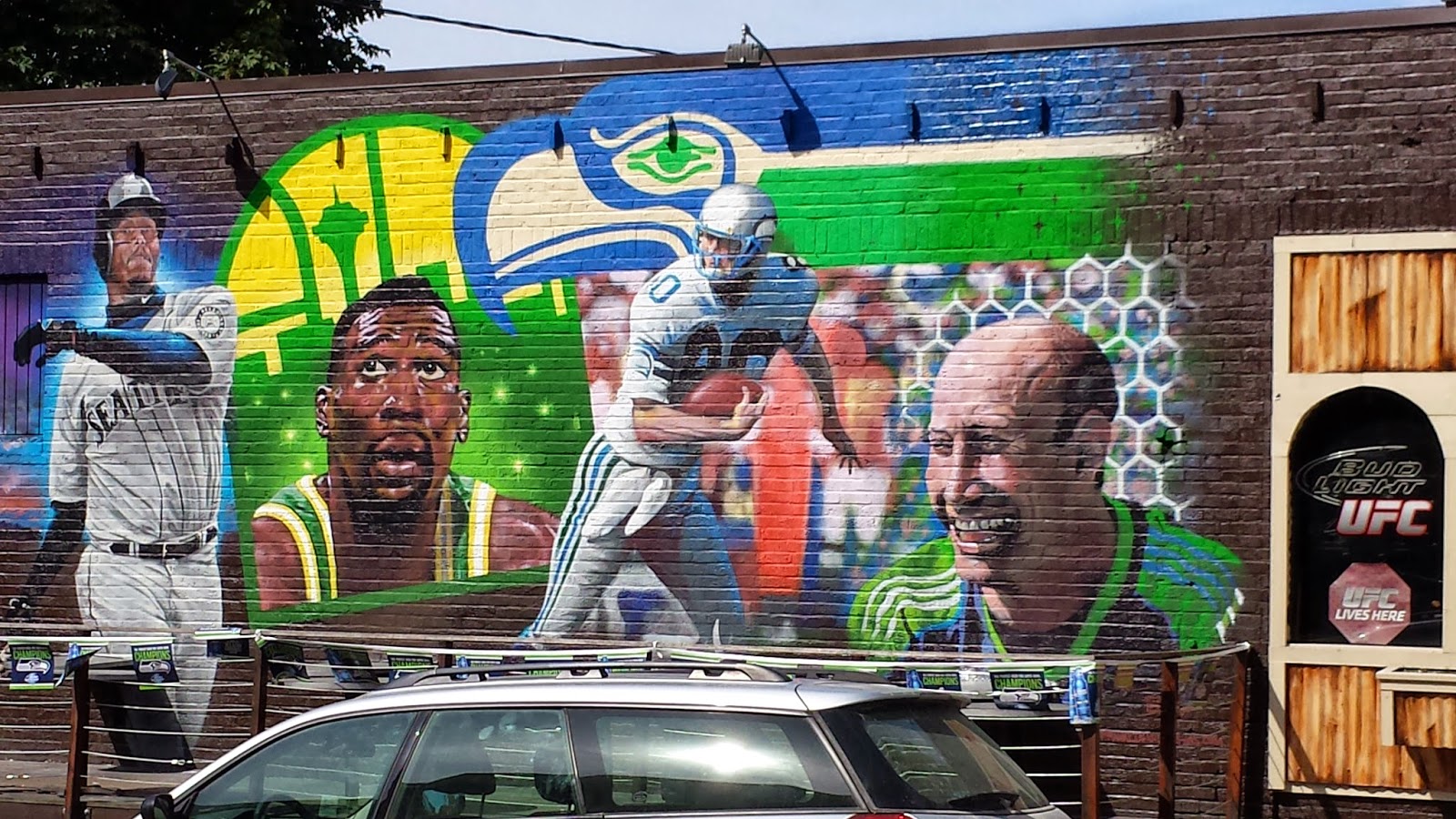
 Seattle, WA. (Wallingford).  45th & Bagley.  Sports mural at the Iron Bull. Photo: Samuel D. Gruber 2014

 Seattle, WA. (Wallingford).  Bartell Drugs Mural 45th Street and Burke Ave. N.. Photo: Samuel D. Gruber 2014

 Seattle, WA. (Wallingford).  45th Street and Burke Ave. N.  Mural by artist Chris Burnside.  Photo: Samuel D. Gruber 2014

 Seattle, WA. (Wallingford).  45th Street and Burke Ave. N. Mural by artist Chris Burnside.. Photo: Samuel D. Gruber 2014

The Murals of Wallingford (Seattle)
by Samuel D. Gruber

Since I just posted about the murals in my own Syracuse neighborhood, I thought I show what some other places are painting in their neighborhoods, too.  There are many definitions of neighborhood, but certainly one way of branding a neighborhood is to give a distinctive visual feel - and murals are a popular and relatively inexpensive way to do that.    Murals vary in quality of execution and subject matter, but even bad murals are often embraced by the local community.  What are the alternatives?  Bleak walls or even better murals.  Or, a high visually engaging urban architecture that is functional and affordable, but also visually stimulating - and fun.  In some times and places (Renaissance Italy murals were painted to enhance and expand the architecture through tromp l'oeil and other fictive devices, a technique revived in New York and other American cities by muralist Richard Haas and disciples beginning in the 1970s.  Most contemporary urban muralists seem to lack the desire or skill to match. preferring a much different aesthetic more akin to spontaneity of certain folk traditions or the slickness of advertising.


Rome, Italy. Pal. Milesi Photo: http://roma.andreapollett.com/S5/rione05.htm.

I recently had the pleasure of visiting Seattle and was fortunate to stay in the Wallingford neighborhood, just a half block off 45th Street. The half mile straight stretch is the heart of the district and is lined with dozens of restaurants, a library, movie theaters and a mix of useful and traditional stores (lamps, etc.) and a trendy new places. 

On either side are residential blocks heavy with early 20th-century Craftsman-style bungalows.  There are many murals all over Seattle, but murals are an especially distinctive part of the 45th Street district.  Some are community oriented; some advertise the businesses whose walls they adorn.  This is not an entirely new practice.  Traces of at least one old painted ad - for Henry Nelson Real Estate - is still visible.  No new mural has been painted on that wall to compete.


Seattle, WA. (Wallingford).  45th Street mural of an earlier age.  Photo: Samuel D. Gruber 2014


Seattle, WA. (Wallingford).  45th Street mural of an earlier age.  Photo: Samuel D. Gruber 2014

 Seattle, WA. (Wallingford).  45th Street mural. Photo: Samuel D. Gruber 2014

  Seattle, WA. (Wallingford).  4515 Meridian Avenue North. Photo: Samuel D. Gruber 2014

  Seattle, WA. (Wallingford).  Off 45th Street mural. Photo: Samuel D. Gruber 2014

  Seattle, WA. (Wallingford).  45th Street mural. Photo: Samuel D. Gruber 2014

  Seattle, WA. (Wallingford).  45th Street mural for Kabul Restaurant.. Photo: Samuel D. Gruber 2014

 Seattle, WA. (Wallingford).  45th Street mural. Photo: Samuel D. Gruber 2014

Saturday, August 30, 2014

Westcott Neighborhood Murals: A Primer on a Community's Artwork

Syracuse, NY. Boom Babies Mural on Harvard Pl. at Westcott St. Photo: Samuel D. Gruber

Syracuse, NY. Boom Babies Mural on Harvard Pl. at Westcott St. Photo: Samuel D. Gruber

Syracuse, NY. "Heart of the Neighborhood," community mosaic Mural on Harvard Pl. at Westcott St. Photo: Samuel D. Gruber

Westcott Neighborhood Murals: A Primer on a Community's Artwork
by Samuel D. Gruber

(Cross posted from My Central New York)

Westcott Street has been hopping this summer - with lots of street life at the cafes, restaurants, the new bakery and the Westcott Theater, a popular contemporary music venue.  The Save the Rain Project closed the street some days and caused dislocation, but it is now passed and finally the painted crosswalks have been replaced   Life on the street is good.

Westcott Street - or the "Westcott Nation" as it still sometimes called, is known visually for its murals - the biggest collection of exterior public painted and mosaic wall decoration in the city.  Compared to the mural programs in places like Philadelphia, or even on 45th Street in Seattle's Wallinford neighborhood, this is small potatoes...but the neighbors of Westcott are proud and involved in their murals, so they are not to be taken lightly.  In almost every way this a poplar art, made and promoted by many of the people who witness the murals everyday.  

Thus, I was surprised to find that there is no handy guide to the Westcott wall art.  So here is an introduction: 

The Boom Babies Mural (above), on south wall of 489 Westcott St., is one of the most popular in the neighborhood.  It was painted in 2002 by Michael Swatt and replaced an earlier work created in the 1990s.  Both of the murals utilized a flat pattern language of advertising graphics and poster art to create identification with and nostalgia for past stylish decades, recreated in the vintage and exotic fashions  offered by Boom Babies owner and mural sponsor Lorraine Koury.   The first Boom Babies mural inspired others,  initiating a what has become a tradition of mural painting in the neighborhood.

Syracuse, NY. "Heart of the Neighborhood," community mosaic Mural on Harvard Pl. at Westcott St. Photo: Samuel D. Gruber
 
Across the street at the rear of 501 Westcott Street (SE corner of Harvard Pl) facing east, is the 6' x 8' mosaic tile mural “Heart of the Neighborhood,”  designed by SU professor and former Westcott Neighborhood Association board member Marisa Temple and created by community residents,   as part of a project by the Neighborhood Association and begun at the Westcott Street Fair in 1998.  The mural was installed in 1999.

Syracuse, NY. "Peace by Piece," mosaic at Petit Library. Photo: Samuel D. Gruber

Another related mosaic mural was installed on the east wall of Petit Library in 2011.  This work was a project of local artist and teacher Ann Cofer; Ed Smith K-8 School art teacher Mary Lynn Mahan; and students from Ed Smith School.  The mosaic mural, is called Peace by Piece, and represents white doves against an abstract background. It is inspired by a paper cut work by Matisse; Polynesia, the Sky.  Cofer and Mahan adapted Matisse's design into shapes the students could make with single or groups of tiles.    About 175 students from grades three to eight worked on the mosaic during the 2010-11 school year.  New tiles were created, and these were mixed with left over tiles from the 1999 mural on Harvard Place.  The library was an active participant in the process, as was the Syracuse Public Art program and the Westcott East Neighborhood Association which had sponsored the previous mosaic.  The new tiles were filed in a kiln at Syracuse University.  The mural which was made by gluing the tiles onto cement boards and was installed by city employees.  It was unveiled on September 24, 2011.  [see: Greg Mason, "Pieces Linked to Make Mosaic," The Post-Standard / Neighbors City (November 10, 2011).

 
 Syracuse, NY. Community mural by Michael Moody at Westcott and South Beech Streets.   Photo: Samuel D. Gruber

Local artist Michael Moody was commissioned by the Westcott East Neighborhood Association in 1997 to paint a mural.  The mural was developed out of a much more comprehensive project of community involvement and planning aimed to revive the Westcott Commercial District.  The scene represents neighborhood residents, including Tony DeLuca, long-time resident and proprietor of Abdo's grocery store (and father of most recent owner Ron DeLuca), who died the year the mural was completed.  Abdo's,  operated by the DeLuca family since 1936, was recently sold to a new owner, and the name will be changed.

Syracuse, NY.  Seven Rays Landscape mural by Jeff Bowe (destroyed), painted in 1990.

In 1990 Jeff Bowe painted an expansive, fantastic and idyllic landscape on the side of the Saven Rays bookstore, long a destination counter-culture business on Westcott Street.  Part of Bowe's work was destroyed during repair of structural damage which required removal a large section of the work. 

In response, in 2012 a committee of the Westcott Area Cultural Coalition, the same organization that oversees the Westcott Street Cultural Fair, began searching for an artist for a new mural on the north wall of the building that now houses the Asahi Japanese Restaurant and Beer Belly Deli.  In preparation for the project the Coalition had asked residents of Westcott to answer the question “What does Westcott mean to me?” Artist Alex Biegler’s design was selected through an RFP process. Biegler, is a Texas native and graduate of Syracuse University. The new mural, completed in 2013, was funded by a grant from the Cultural Resource Council (Now CNY Arts) and the owner of the building. 

 Syracuse, NY.  Alex Biegler at work on Westcott mural.  Photo: Samuel D. Gruber (2013)


Syracuse, NY. Westcott mural by Alex Biegler (2013). Photo: Samuel D. Gruber

In presenting the design, Biegler wrote "the mural aims to take a universal approach by discussing the idea of community itself.  This will serve both to confirm and challenge the public by providing a mirror of what they already value and connecting this value to its importance with the past, present, and future of the earth."  True, this statement is pretty vague...but still in one way at least it gets to the heart of the subject matter.  The mural present idealized views - silhouettes - of 139 natural forms, mostly referring to various species of tree, birds and beetles.  One can view these a community of related living forms, or a matrix related visual images.  Enclosing each silhouette in a box, however, recalls not a natural community - but an artificial one - that consists of the pinned specimens of entomology class. But the grid also recalls the grid of the Westcott Neighborhood, with each specimen inhabiting its own little block.

Read more here.


Sunday, August 24, 2014

Happy Birthday Jacques Lipchitz

Cross posted from Samuel Gruber's Jewish Art and Monuments

Happy Birthday Jacques Lipchitz (born Aug. 22, 1891)
by Samuel D. Gruber

Since I'm getting ready to begin teaching my "Jewish Art: From Sinai to Superman" class next week, I thought I'd resume my birthday shout outs for prominent and interesting Jewish artists and architects. Given the name of the course, posthumous felicitations to Lithuanian-born Jacques Lipchitz, born on this day in 1891 in Druskieniki, Lithuania, seem appropriate since a  common theme in his later work was that heroic struggle - often involving a Biblical character.  

Though not quite Superman, David is a superhero as he struggles with Goliath in Lipchitz's 1933 allegorical piece - an important early artistic statement about the Jewish struggles in Europe at the beginning of the Nazi era.  Similarly, a heroic Jacob wrestles with an angel.  Both are allegories for the individual and collective struggles of the time.

 Read the entire post here.