Search This Blog

Saturday, January 26, 2013

Mestrovic and Job in Paris and Syracuse


Paris, France. Job  by Ivan Mestoric (1945) on view at the Musee Rodin.  Supplicant Persephone (1945) can be seen standing in the court in the bottom image.  All photos: Samuel D. Gruber 2013

Mestrovic and Job in Paris and Syracuse

by Samuel D. Gruber

Visiting the Musee Rodin in  Paris a few weeks ago brought me face to face with an old friend - Ivan Mestrovic's agonized bronze statue of a crouching, suffering Job.  The work, completed in 1945 in Rome finalized a vision of Job that Mestrovic first conceived when in a fascist prison in Croatia in 1941.  Both Job and a companion piece of a Supplicant Persephone were exhibited at Mestrovic's one-man exhibit at New York's Metropolitan Museum of Art in 1947 (the first such show the Met had ever mounted for a living artist).  Today, the works face each other across a small courtyard at Syracuse University, where I pass them almost every day.  Both these works are presided over by a larger relief of Moses, a bronze made in 1990 from Mestrovic's plaster version designed for the un-built monument to the Six Million designed by architect Erich Mendelsohn, which was planned for Riverside Park in New York City but never built (more on that work in a future post).
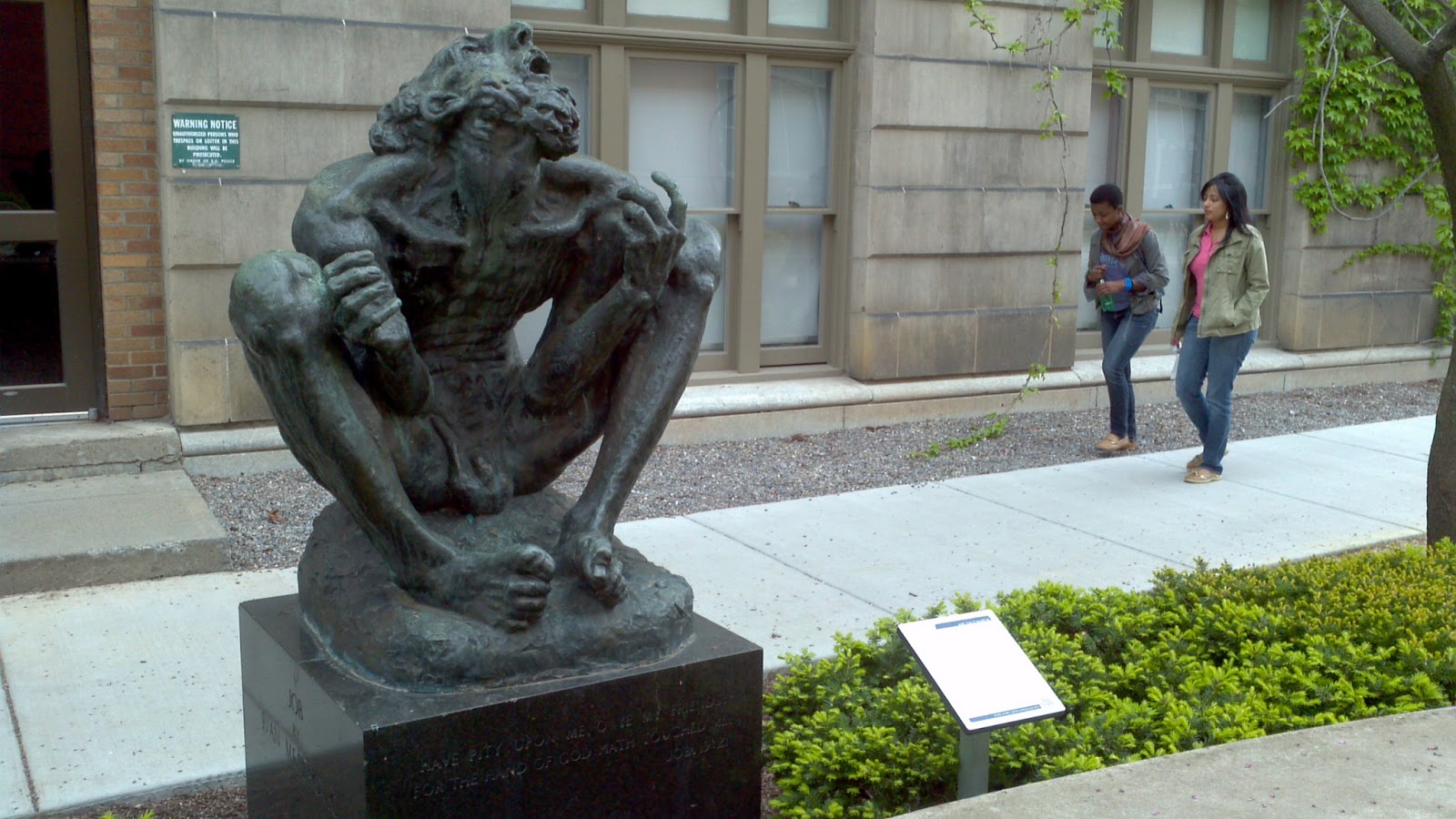

Syracuse, NY. Job by Ivan Mestrovic (1945) in the Shaffer Sculpture Court outside of Bowne Hall. Photo: Samuel D. Gruber 2012.

Versions of Job and Persephone from the Ivan Meštrović Museums in Croatia were both installed in the Court of Honor at the Musee Rodin, as part of small but powerful exhibition of Mestrovic's work  coinciding with festival Croatie, la voici. 

Syracuse, NY. Supplicant Persephone by Ivan Mestrovic (1945) in the Shaffer Sculpture Court outside of Bowne Hall. Photo: Samuel D. Gruber 2012. 

In Syracuse these works are among the very best figurative sculptures in a city that boasts an impressive collection of public bronzes. I teach these works in my Holocaust, Memory and the Visual Arts class.  In Paris, however, despite that fact that I was in the midst of exploring the city's commemorative landscape, these works took on - in the context of Rodin's work - a different, but related, meaning.  The anguish expressed by both figures was still powerful, but due to their museum siting it was dissipated.

On the other hand, since the works were in only a stone's throw from Rodin's great group of suffering figures, the Burghers of Calais (Les Bourgeois de Calais), and also of bronzes of all the constituent figures in the that work (the work has been cast twelve times in all, and can be seen in various configurations in different cities), the line from Rodin to Mestrovic was very clear.  The mix of defeat, anguish, anxiety in the posture and gestures of the Burghers of Calais figures, laid over expressions of nobility, made this an exceptional public monument when it was unveiled in 1889 and still today. As with Mestrovic's Job, Rodin's work has inspired any number of subsequent commemorative depictions of victims - especially Holocaust victims.


Paris, France. Musee Rodin.  The Burghers of Calais by Auguste Rodin. Photos: Samuel D. Gruber 2013.

Both the preliminary designs for Job and Persephone express Mestrovic's personal anguish as a prisoner in 1941, when he expected death at the hand of Italian Fascists.  His political stances from the First Wold War period (in defiance of both Austria and Italy) and his refusal in the mid-1930s to accept a Nazi invitation to exhibit his work in Berlin, which Hitler himself would open, made him a persona non grata in occupied Yugoslavia.  Subsequently, these works as executed in bronze have been accepted as larger expressions of pain, remorse and despair in the wake of all the destitution in Europe brought about in World War II.   Mestrovic's first wife Ruza was Jewish and she died in Zagreb in 1942 and at least 30 members of her extended family also died in the Holocaust.  But Mestrovic knew many people - Jews and Christians - in artistic, political and others circles who suffered and died in the war.

Not surprisingly, Mestrovic was not the only artist of the time to use Job as a symbol of the suffering during the war.  Coincidentally, probably the best known painting of the theme, Francis Gruber's Job of 1944 from the Tate Galley in London, is also on view in Paris in the important - though rambling - exhibition L'Art en Guerre: France 1938-1947 on view at the Musée d’Art Moderne (through February 17, 2013).  Gruber (no relation to me) painted his Job for the Salon d'Automne (the so-called Salon of the Liberation) of 1944,  just after the Liberation of Paris.   Gruber's Job is a naked, forlorn and vulnerable man seated on a stool by a broken gate or fence.  According to the Tate online catalogue "Gruber painted this picture ... to symbolise the oppressed peoples who, like Job, had undergone a great ordeal of suffering. The inscription on the paper at which the figure is looking reads: 'Maintenant encore, ma plainte est une révolte, et pourtant ma main comprime mes soupirs'. This is taken from The Book of Job, 23.11"   This Job is essentially passive - there is none of the animal anguish Mestrovic brings to the subject. 

It is significant that Gruber and Mestrovic both chose the figure of Job to channel their fears and faith about World War II and its aftermath.  For Jews and Christians alike, Job was the Biblical figure who embodied universalism.  Rabbis debated who he was, when he lived of if he was real at all.  Many saw him as the archetype Righteous Gentile, others a fictional device for teaching the love and fear of God.   Still, both Jews and Gentiles took him for their own, and his suffering represents the suffering (and hope) of all.  For Christian artists especially Job was an appropriate subject, that could linked to Jewish tradition (and contemporary suffering), but could also be interpreted in many other ways.

Job by Francis Gruber (1912-1948). Tate Museum, London. Photo: Courtesy of the Tate Museum

How did Job and Persephone get to Syracuse?  Mestrovic was born in Croatia in 1883 but by the 1920s he was very popular in the United States, where he had a successful exhibition at Brooklyn Museum in New York in 1924, which led to his commission for giant Indians (Bowman and Spearman) in Chicago,  installed in Grant Park in 1928.  In 1947 Syracuse University Chancellor William P. Tolley arranged for Mestrovic to come and teach at Syracuse University, where he stayed until 1955 before moving on to Notre Dame, where he taught until his death in 1962.  He brought many of his recent and in progress works to Syracuse, where he worked on them, and trained a generation of young sculptors. You can read about Mestrovic at Syracuse here, and in a longer article by David Tatum here.  Notre Dame hold a large collection of Mestrovic papers, the finding aid is here.


Tuesday, January 15, 2013

George Washington in Paris

Paris, France. George Washington Equestrian Statue at Place d'Iéna by Daniel Chester French (1900). Photo: Samuel D. Gruber (Dec. 2012)

George Washington in Paris
by Samuel D. Gruber


I came to Paris and saw old friends - people and monuments.  Americans are common, in flesh and bronze, and their comings and goings over two hundred years can often be traced in the many commemorative plaques one finds attached to buildings walls, and in a series of monumental statues placed around the city, but especially in the 16th arrondissement. George Washington and Benjamin Franklin are fixtures in the neighborhood.

Paris, France. George Washington Equestrian Statue at Place d'Iéna by Daniel Chester French (1900). Photo: Samuel D. Gruber (Dec. 2012)

George Washington never came to Paris in his lifetime, but he is here bigger than life dominating two public spaces, and his image can probably be found elsewhere throughout the city.  Once (at the Place d'Iéna) he is carried on a feisty horse, and once (at the Place du Etats-Unis) he carries, together with his bon ami and protege Lafayette the banners of liberty the flags of the United States and France.

Both works are by sculptors well-known to Americans.  The bronze Equestrian Statue of a very marshal George Washington is by Daniel Chester French, known for his monumental Lincoln Memorial statue, and about whose Richard Morris Hunt monument I recently wrote.  The Washington statue was inaugurated July 3, 1900, the gift of a committee of American women. The text of the statue reads: "gift of the women of the United States of America in memory of the brotherly help given by France to their fathers in the fight for Independence."

 At the Place d'Iéna Washington raises his sword - presumably to advance into battle.  But mostly he combats of the thousands of cars that circle past every day.  Fortunately, horse and rider are raised on a high base, so Washington always rises above the fray. 


Paris, France. George Washington Equestrian Statue at Place d'Iéna by Daniel Chester French (1900). Photos: Samuel D. Gruber (Dec. 2012)

Washington and Lafayette are the work of Frédéric Auguste Bartholdi, creator (with Gustav Eiffel) of the Statue of Liberty.  Apparently newspaper publisher Joseph Pulitzer was so  impressed by Bartholdi's Statue of Liberty that he commissioned a statue symbolizing French-American friendship to be installed in Paris. It was dedicated in 1895 at the Place des États-Unis (a replica later erected in Manhattan's Morningside Park, New York).  

Here, Washington is in a quieter setting, set upon a green rectangle at one end of the Place des Etats-Unis.  In the center of the long narrow place is a playground, and several other monuments with American associations are place at other parts of the square.  The square is lined with impressive mansions.  Only a short distance from the much busier Place de l'étoile and the Arc de Triomphe. 


Paris, France. Washington and Lafayette Status by Bartholdi (1895). Photos: Samuel D. Gruber Dec. 2012)

Paris also has a Rue Washington that connects with the Avenue des Champs-Élysées.  It was named after the  American general and president in 1889.


Thursday, January 10, 2013

Another Architect Remembered: Andre Le Notre Monument in Paris


Paris, France.  monument to landscape architect André Le Nôtre at the Garden of the tuileries.  Photos: Samuel D. Gruber (2013)

Another Architect Remembered: André Le Nôtre Monument in Paris

by Samuel D. Gruber
I wasn't consciously looking for architect monuments when recently in Paris, but en route to an exhibit at the Orangeries I encountered famed French landscape architect André Le Nôtre (1613-1700) captured in bronze at the edge one of his most trafficked (and much altered) creations, the Gardens of Palais des Tuileries.  This monument can keep company in this blog with that of Richard Morris Hunt in New York, which is fitting, as Hunt most certainly spent time strolling in  Le Notre gardens during the years he spent in France.

Paris, France.  monument to landscape architect André Le Nôtre at the Garden of the tuileries.  Photo: Samuel D. Gruber (2013)

The monument lists André Le Nôtre greatest works.  He Transformed the gardens of the Tuileries Palace, first laid out in the mid 176th century, into a grand formal garden that stretches between the Louvre and the Place de la Concorde, opened to the public in 1667.  Since the 19th century, it has been a primary place for Parisians to gather to relax and celebrate.  I don't know when this monument was installed near the entrance by the Place de la Concorde, but it appears to be fairly modern.  The bust was clearly made after an earlier sculpted commemorative portrait of Le Notre by Antoine Coysevox.


Paris, France.  Bust of André Le Nôtre from Tuileries monument (photo: Samuel D. Gruber)  and marble bust by Antoine Coysevox reportedly at the church of St. Roch. (Photo: http://www.art-prints-on-demand.com).

The park has undergone many transformations and many classically-inspired statues were added throughout the 19th century.  In recent decades more modern works have also been included on both permanent and temporarily basis.

Paris, France. View from near the Le Nôtre monument looking out of the Tuileries Gardens toward Place dfe la Concorde. What would Le Nôtre have thought (and does it matter)?. Photo: Samuel D. Gruber (2013).

Monday, December 10, 2012

Remembering an Architect: The Richard Morris Hunt Monument in NYC


New York, NY. Richard Morris Hunt monument. Fifth Avenue at 70th Street.  Daniel Chester French, sculptor.  Postcard view, early 20th century (above) and recent photo (Photo: Samuel D. Gruber 2012).  The monument is a time portal, unchanged in a hundred years. 

 Remembering an Architect: The Richard Morris Hunt Monument in NYC

Poor architects, I think they rank  behind soldiers, politicians, writers, artists and a host of other notable professionals when it comes to being commemorated in marble or bronze, or any other permanent material.  Of course, an architect will always say his (or her) buildings are monuments enough.  Maybe true - but I've met very few architects without healthy egos, who would say no to a monument like the one for 19th-century America's leading academic and society architect Richard Morris Hunt (1827-1895).  Charles Follen McKim of McKim Mead and White only got a plaque in the pavement at Columbia University, which he designed.  (What's your favorite memorial to an architect?)

 
 New York, NY. Columbia University. Charles Follen McKim commemorative pavement. Photo: Samuel D. Gruber

Hunt's monument is lovely.  Sculpted by Daniel Chester French and unveiled in 1898, it is dignified, but intimate; architectural; but sliding into the cityscape/landscape of Fifth Avenue against Central Park like the planting of an appropriate tree.  The monument is designed as a free-standing semicircular portico (an exedra) with a curved bench at the center of which is a bronze portrait bust of Hunt beneath which is inscribed:


RICHARD MORRIS HUNT
October 31, 1828
July 3, 1895
In Recognition
Of His Services To
The Cause of Art
In America
This Memorial
Was erected 1898 by
The Art Society
of New York

Two allegorical statues of Architecture and then Painting and Sculpture stand guard at the ends of the colonnade. The names the organizations in which Hunt played a major role are inscribed.

New York, NY. Richard Morris Hunt monument. allegorical figures of Architecture (top) and sculpture and painting (below).  Daniel Chester French, sculptor.  Photos: Samuel D. Gruber 2012.

Hunt was a pivotal figure in American architecture.  He bridged high Victorian art and French-inspired classicism, and he laid the foundation for and academic architectural training in architecture in America  that shifted emphasis from engineering to art.  Hunt's aesthetic led to the integration of architecture, sculpture and painting at the end of the 19th century the defined the design goals of the so-called Amerasian Renaissance.  The sculpture of the monument, Daniel Chester French play a major role in this movement, and it explains the prominent given to painting and sculpture in a monument to an architect. This integration of the arts is also central to the conception of the Metropolitan Museum of Art facade, which Hunt redesigned in 1895, shortly before his death, and which was completed in 1902.  


New York, NY. Metropolitan Museum of Art facade. Central part designed by Richard Morris (1895) and completed by Richard Howland Hunt (1902). Photo: Samuel D. Gruber 2007

Despite his fame in his lifetime, only a small number of Hunt's buildings still stand.  In New York City, the best known of these is the central block of the Metropolitan Museum of Art, facing Fifth Avenue just a half mile north of the monument. Hunt was the favored architect of the wealthy Vanderbilt family and while the Fifth Avenue Vanderbilt mansion has been demolished, the great Newport, Rhode Island mansion known as The Breakers, completed just before his death, as well other great houses, are today popular tourist attractions.  The enormous Vanderbilt mansion known as Biltmore in Ashville, North Carolina also survives. 

Newport, Rhode Island. The Breakers. Richard Morris Hunt, architect (1895). Photo: Samuel D. Gruber 2008


Newport, Rhode Island.  The Breakers, detail of mosaic floor.  Richard Morris Hunt, architect. Photo: Samuel D. Gruber 2008.

 New York, NY. Richard Morris Hunt monument.  Mosaic decoration recalls Hunt's work. Photo: Samuel D. Gruber 2012.


Tuesday, November 13, 2012

Belgium: Anglo-Belgium War Memorial

 
Brussels, Belgium Anglo-Belgium War Memorial.  Photo: Samuel D. Gruber (2009)

Belgium: Anglo-Belgium War Memorial (1923)

Europe is covered with war monuments like a measles patient has spots.  You can find them in every village and town, in every country.  Big cities have big monuments, and small ones tucked away in small parks and on street corners.  These vary tremendously in their effect as vessels of memory, as works of at and as urban decoration and the backdrop for public ceremony.  

I am partial to the monuments of World War I.  It was a big war with terrible consequences, and many of the memorials are big monuments with bold forms in striking postures - though few if any were allowed to depict scenes of suffering and death.  A good example of this is the Anglo-Belgian War Memorial in Brussels, Belgium, commissioned by the British Imperial War Graves Commission and designed by the British sculptor Charles Sargeant Jagger (1885–1934).  In Belgium it is known as the Brits Oorlogsmonument in Dutch and the Monument Britannique in French.  It is built as a wide wall-like cenotaph.
 

Brussels, Belgium Anglo-Belgium War Memorial.  Photo: Samuel D. Gruber (2009)

Unlike many monuments, it does not commemorate a heroic battle, but rather the support given by the Belgian people to British prisoners of war.  The tall central figures in high relief represent a British and a Belgian soldier.  On wither side are low reliefs depicting wounded British soldiers aided by Belgian peasants.  It was unveiled by the Prince of Wales in 1923.  The monument is carved from Brainvilliers stone.  Casts of the reliefs are at the Imperial War Museum, London.  A plaster cast of the Belgian soldier is held in the Army Museum in Brussels.

Strength and nobility of purpose were the overriding themes of World War I monuments  - as if the posture of these monuments could make the population forget the immeasurable and often pointless suffering and destruction of the war.  For those memories one needs to turn to post-war literature and art. Still, the bold and sometimes heavy-handed imagery of these monuments endured, and Jagger's sculptures for the Brussels monument foreshadows the public sculptural style favored by the 1930s by powerful image-conscious states - whether Fascist Italy, Nazi Germany, Communist Russia or the democratic but capitalist United States.

 
 Brussels, Belgium Anglo-Belgium War Memorial.  A pedestrian hurries past the monument, without considering its purpose.  Photo: Samuel D. Gruber (2009)

This type of war monument is very different in form and purpose to many earlier war memorials - such as those American Civil War monuments in Detroit, Michigan (1872) and Troy, New York (1891) I have written about, and the contemporary and nearby Infantry Soldiers Monument in Brussels at place Poelaert (1935), that served as central organizing points in the urban plan, punctuating an important intersection, and often serving as a visual focal point for long street vistas. Such monuments often include tall columns or obelisks.  

This Brussels monument is a wall to be passed by, but become animated when it serves as the backdrop to commemorative ceremonies.  When used like the scaenae frons of a theater, in front of which the appropriate - but varied activities take place, memory can be triggered, reformulated and invigorated.  Or, it may more resemble in purpose a temple front - before which the same activity takes place year after year following a remembered but formulaic liturgy, important to those who have first-hand experience of the event commemorated, but entirely foreign to all others.  For all such monuments deciding how they will be used determines how they will be understood.

The resemblance to a giant gravestone encourages the placement of wreaths and flowers upon the projecting ledge at the base. There are many examples of this type of monument.  One of the best known is the Warsaw Ghetto Uprising Monument, dedicated in 1948.


Sunday, November 11, 2012

For Veterans / Armistice Day: More Monuments of Jews who Died in World War I


For Veterans / Armistice Day: More Monuments of Jews who Died in World War I  
by Samuel D. Gruber (all photos Samuel D. Gruber 2011)

(cross-posted from Samuel Gruber's Jewish Art & Monuments)

Today is Veterans' Day - originally  Armistice Day - celebrating the end of the First World War - the War to End all Wars (that didn't).  In honor of all Veterans, but especially Jews who fought and died on both sides in World War I, I refer you to some images of Jewish war memorials from Italy, Hungary and the Czech Republic that I first put only line in May 2009.

I am also adding a new one from the New Jewish Cemetery in Worms, Germany that I visited in 2011. worms, is much better know for its Old Jewish Cemetery and medieval synagogue and Judengasse, but it had a prosperous Jewish community until the rise of Hitler.

The Jewish community had been trying since the late 19th century to establish a new burial ground, since the old Jewish cemetery was filled.  In 1910 the community was able to establish the Hochheim cemetery, right next to the Hauptfriedhof Worms (Friedhof Hochheimer Höhe), with a separate entrance. The new cemetery was inaugurated in 1911, just a few years before the war.  


Inscribed in gold letters over a triumphal archway is the phrase "Unsern Henden" (Our Heroes). 


 Nineteen of Worms' Jews were killed in the war, their names are listed on the monument.

  
The monument was restored in 2006 with help from the Rotary Club Worms.


Ruth Ellen Gruber has posted more examples of Jewish War Monuments on her blog. Click here.

Saturday, November 10, 2012

Troy, New York's Towering Civil War Monument at the Center of Renewed City Life

Troy, New York's Towering Civil War Monument at the Center of Renewed City Life
by Samuel D. Gruber


Troy, New York. Monument Square (formerly Washington Square).  Historic postcard and contemporary view.

I love looking at Civil War monuments, in part for the story they tell about the war and those who served, fought and died, but also because more than any other group of American public artworks they are also often integral elements in the cityscape, or sometimes in a cemetery landscape.  This is especially the case in Troy, New York where the 90-foot tall Soldiers and Sailors Monument at Monument Square, with its bronze statue "Call to Arms" perched atop its summit, sits at an intersection of River Street, 2nd Street and Broadway at the heart of a revived and increasingly vibrant downtown.  The Saturday Farmers' Market spreads out on all ides of the triangular "square" and north on River Street.  

Troy, NY. Soldiers and Sailors Monument.  Fuller & Wheller, archs.; John E. Kelly, sculptor (1890-91). Photo: Samuel D. Gruber

The Square is now part of the Central Troy Historic District, the largest urban National Register Historic district in the United States. 

The hey-day of Civil War monuments also corresponds to the greatest period of American, figural and monumental sculpture, that era we now refer to as the American Renaissance, dominated by sculptors Augustus Saint-Gaudens (1848–1907), Frederick William MacMonnies (1863-1937) and John Quincy Adams Ward (1830-1910), but also graced with many other fine (though now largely forgotten) artists. 

 
Troy, NY. Soldiers and Sailors Monument.  Fuller & Wheeler, archs.; John E. Kelly, sculptor (1890-91). Photo: Samuel D. Gruber

The use of a tall column for a military monument is ancient in origin, and Trajan's column in Rome is the best known example.  But tall columns as monuments were popular in the United States in the 19th century, the best known being Robert Mills' Washington Monument in Baltimore (1815-29).  The Troy monument was erected in 1890-91 and dedicated in September 1891.  The design is by  Albany architects (Albert W.) Fuller & (William Arthur) Wheeler. The construction contract was awarded Frederick & Field, of Quincy, Mass.

The cornerstone was laid on Decoration Day, Friday, May 30th, 1890.  In addition to the usual laudatory speeches, there was "a large procession of veteran soldiers and the military organizations the city, under the direction of Major-General Joseph B. Carr, chief marshal, and the singing of dedicatory and patriotic hymns by five hundred school children."  Even more lavish celebrations, as described in the New York Times, marked the completion and dedication of the monument the following year.

The robust tri-partite base of the monument is one of the last full-blown examples of a medieval style made more muscular and angular, pioneered by Philadelphia architect (and Civil War veteran) Frank Furness.  The style that was popular in American after the 1876 Philadelphia Centennial exposition (and Furness's Provident Life and Trust Building of the same year), but was replaced in most public buildings and monuments by Roman-inspired classicism after the success of the "White City"of the 1893 Chicago Colombian Exposition.

The base supports four bronze relief plaques representating the cavalry, infantry and artillery branches of the Union military service and a fourth plaque representing the naval battle between the Monitor and Merrimac.  Atop the tall granite shaft is the bronze statue titled " Call to Arms" by New York sculptor James E. Kelly (1855-1933). Kelly was a leading illustrator and sculptor of Civil War scenes and the creator of many monuments throughout the country. 

Troy, NY. Soldier and Sailors Monument.  John E. Kelly, sculptor (1890-91). Photo: Samuel D. Gruber

Kelly's bronze reliefs revive the lively style of Civil War illustration popularized in magazines such as Harper's during the war, but they also draw from classical Greek and Roman sources; casts and engravings of which were plentifully available in late-19th century America.  But it is also likely the Kelly was aware of the Edward Muybridge's studies of animal locomotion widely presented since 1878. The composition of Kelly's cavalry charge brings to mind the famous Parthenon frieze, but the lively movement of the horses suggests Muybridge's motion studies. 

Troy, NY  "Calvary" from Soldier and Sailors Monument.  John E. Kelly, sculptor (1890-91). Photo: Samuel D. Gruber
 
 
Athens, Greece. Detail of the Parthenon frieze.

http://upload.wikimedia.org/wikipedia/commons/7/73/The_Horse_in_Motion.jpg 
"The Horse in Motion" by Edward Muybridge (1878)

Kelley also provided a bronze panel celebrating the Union artillery in which the big wheel of the cannon takes central place in high relief. 

 Troy, NY.  "Artillery" from Soldiers and Sailors Monument.  John E. Kelly, sculptor (1890-91). Photo: Samuel D. Gruber
 
  
 Troy, NY. Soldiers and Sailors Monument.  Fuller & Wheeler, archs.; John E. Kelly, sculptor (1890-91). Photo: Samuel D. Gruber

Troy, NY. Soldiers and Sailors Monument.  Fuller & Wheller, archs.; John E. Kelly, sculptor (1890-91). Photo: Samuel D. Gruber

 Troy, NY. Soldiers and Sailors Monument.  Fuller & Wheeler, archs.; John E. Kelly, sculptor (1890-91). Photo: Samuel D. Gruber